
At Milkwood, we spend the majority of our time focusing on positivistic strategies for an uncertain future. This is mostly because the other way of looking at the future has a big flashing ‘here be dragons’ sign on it.
Like everyone else, we know what’s happening out there in the big wide world. We know that there’s many gigantic problems, that the climate is changing, and that our granchildren’s world will definitely not look like this one.
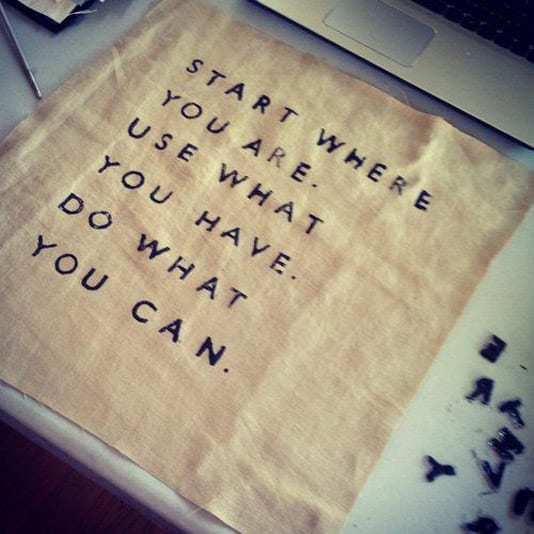
It’s scary stuff. And yes, it does sometimes keep me awake at night. But then it’s morning again. Start where you are, use what you have, do what you can.
Part of our resolutely positive attitude has to do with our education enterprise, I suppose. We made a conscious decision with Milkwood to focus on empowering and encouraging people, not scaring them witless with scenarios of doom that they had to ‘survive’.
Mostly because we know that, while fear can be very motivating in the short term (and might be an effective marketing strategy), it is not a good place to be coming from when you’re trying to create long term resilience, or enduring community, or a strong state of mental health.
So we’ve always been very careful with how we’ve talked about and approached the great re-skilling. Because I would rather be motivated by goals of competence and health of my family and community. And we’d rather teach skills and design theory from that same place.
Start where you are, use what you have, do what you can.
As I’ve noted after writing Survivalism is the new Black and Why I’m not down with the whole Zombie Apocalypse thing, there’s another reason for focusing on positivism. The alternative gets everyone very, very upset.
So while I know that positivism won’t (on its own) change the climate chaos, or shift our fossil fuel dependancies, it does do one very important thing:
Positivism allows us to get the hell on with doing what we can, instead of circling endlessly in a loop of statistics, critics, counter critics, debunkers and a general emotional quagmire.
And by positivism I don’t mean some happy clappy it’s all sunshine and daisies attitude.
I mean staring the dragons in the eye and acknowledging that they are there. Then rather than withering in fear, choosing to go plant seeds, teach courses, devise resources, make contraptions, have campfires, cook food, talk to people, get the **** off facebook, learn from each other, support awesome projects, and generally get the heck on with it.
Get the heck on with sharing knowledge and promoting an approach to living and the planet that will be useful no matter what the future holds.
If green-tech or an effective lowering of emissions saves the day, great. We will know how to grow, design and make things that we consider intrinsic to a healthy, grounded life, regardless.
If green tech or an ineffective lowering of emissions does not save the day… we will know how to grow, design and make things that fill bellies, keep families warm, make things work without relying on fossil fuels and can be used to create functional community.
Which is not to say that the findings in the recent Extreme Weather report by the Climate Commision are something to ignore or take a ‘well at least MY family will be ok‘ attitude to… far from it.
I guess what I am getting that is that after you’ve read the above report, and absorbed all the dire awesomeness of David Holmgren’s excellent Future Scenarios website, and all the rest…
You’ll likely still wake up the next morning. If you sleep, that is.
At which point it will be time to make a pot of tea, and get ready to start where you are, use what you have, do what you can.
Which might be to change government policy, cultivate community, fix pipes or birth babies with skill, elegance and grace. And then go home and grow something. And cook. And consider. And sleep. And rise again with the Sun.
“It is not the project but the living process that will be the measure of our actions.” – David Holmgren