
The kitchen garden is an essential part of any life lived in a house with a yard, in my opinion.
I love the small cycles it brings us closer to with the ebb and flow of growth, flower and fruit. The dry and the wet. And the crunch of harvest.
The rental house we’re in has this sort-of garden around the edge of the small backyard. Lots of possibilities for growing here.
Currently, the garden is basically a perimeter of bricks with a oversupply of woodchips covering a 1m strip of soil that runs around the fenceline, containing a random assemblage of ornamentals.
There’s also a few spindly trees which we think are pussy willows (hard to tell in winter when there’s no leaves and few buds) which I suppose we’re not meant to take out entirely, so we’ve been (ahem) pruning them somewhat to ensure enough light will get through for growing summer greens beneath them.
We know we can rock this space and get it bursting with edible awesomeness. But where to start?
And how far should we go re-arranging the current setup of garden + lawn? Do we treat it as a completely blank slate and go crazy on a new design (and risk landlord wrath and possibly major put-it-all-back costs), or do we work with the existing forms and edges as a starting point?
Decisions, decisions…
For now, we’ve decided to begin within the bounds of the existing garden’s lines, with slight editing of what constitutes said lines – once that’s all planted, we can consider further (and more adventurous) design features within this backyard.
It’s also a matter of getting to know this place, this climate, this site. We’ve been gardening in a very different place these last seven years – different growing season, max/min temperatures, soils, humidity, pests, water availability and all the rest.
But we also want backyard food. Preferably now.
We decided to firstly attack the patch beneath the lemon tree.
The soil here, beneath all the woodchips, is an amazing black bassalt – oh how I would have killed for this soil in our former market garden up in Mudgee! Oh well. Let’s make the most of it now.
Our options for approaching this bed for planting veggies into it were to either fork it over to break the compaction and aerate the soil, or take a no-dig approach and let biology and roots do this same job over a longer period of time.
The forking approach will yield veggies to eat quicker, but also stimulate more weed growth; the no-dig approach is far gentler on the soil, but will take a lot longer to yield the same harvest of food.
As always, it comes down to context: when do you want to be eating out of this garden by? How much yield do you require from the available space? Are you prepared to put in the maintenance (weeding etc) that disturbing the soil with forking will result in?
For us, we’re interested in intensive organic veggie production in a small space. We want to minimise bought greens and herbs. We want to eat out of this garden every day. As soon as possible.
So, we forked.
For this first bed, we planted bought seedlings. I know, its cheating a bit in some ways, but all it takes is a day and TA DA you have a garden. Which is a highly motivating approach, I must say.
I blame the excellent seedling supplier Patio Plants who do many markets on the South Coast and have seriously excellent seedlings for tempting us.
In the next few weeks it will be time to nurture tomato seeds in a sunny indoor space, and plant the beans we collected from last Summer’s bean tipi. Ah Spring – I can’t wait.
But for now, one bed at a time.
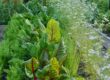
So this day, we forked a bed over and then planted parsley, rocket, spinach, silverbeet, brassicas, fennel, borage and a random rhubarb in the corner where it wouldn’t be disturbed.
We watered it all in with a mix of seaweed emulsion and worm juice.
As mentioned previously, we removed all evidence of madeira vine from the bed, despite it being on par with the spinach.
Next weekend, it’s the next bed, And the next, and so on till we’ve run out of beds. Then we move on to containers, wicking boxes, verticals and trellises…
One bed down. Plenty more to go. Edible backyard, here we come.
What are you planting just now?