
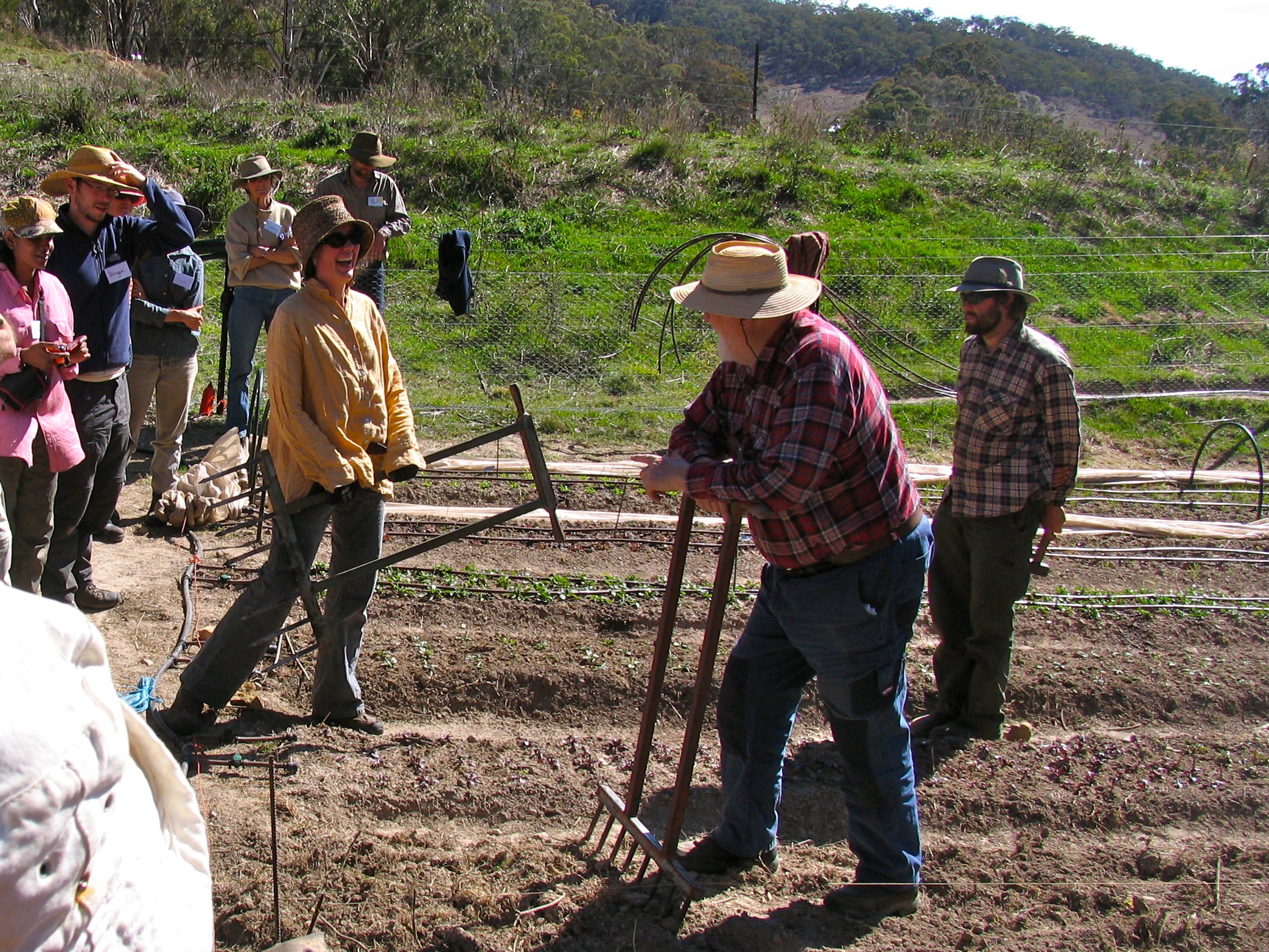
The ‘Gundaroo Tiller’ is an Australian adaptation the traditional European broadfork, and an essential tool for our small market garden. It may look like just a big clunky fork-thing, but it is actually a finely tuned instrument of permaculture soil conditioning goodness. Truly.
Famously, when Allan Yeomans‘ saw his first Gundaroo Tiller, he called it ‘A Keyline plow for gardeners’. For us, it’s an essential part of creating aerated soil structure on compacted pasture without inverting the soil…
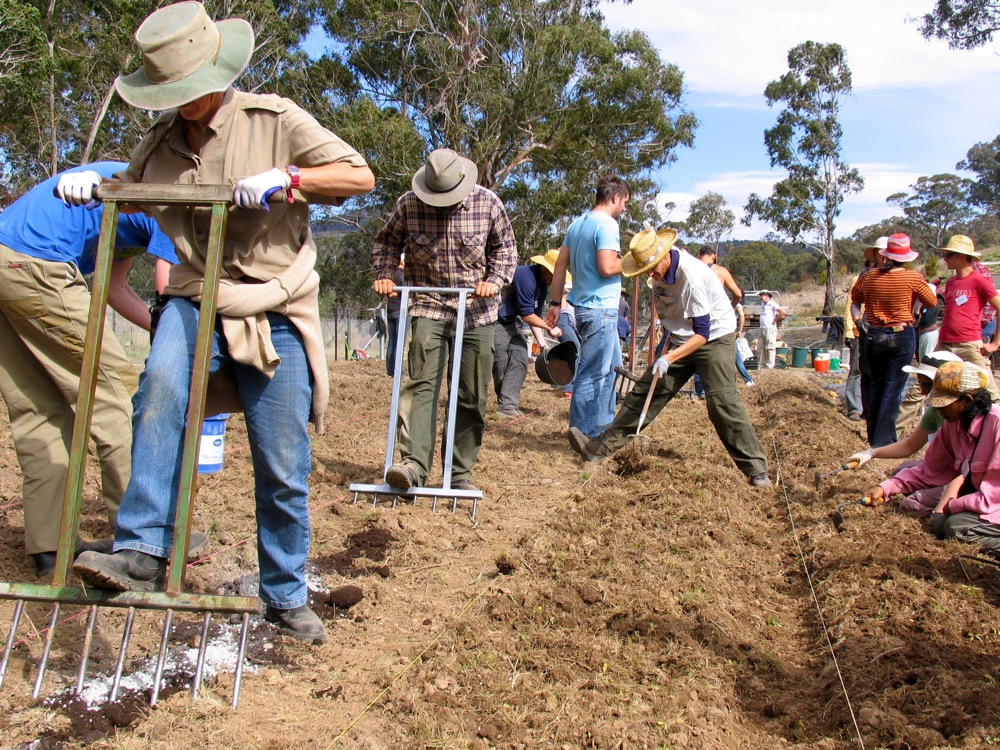
Gundaroo Tillers in action during a Milkwood Farm ‘Starting an Organic Market Garden’ course last Spring
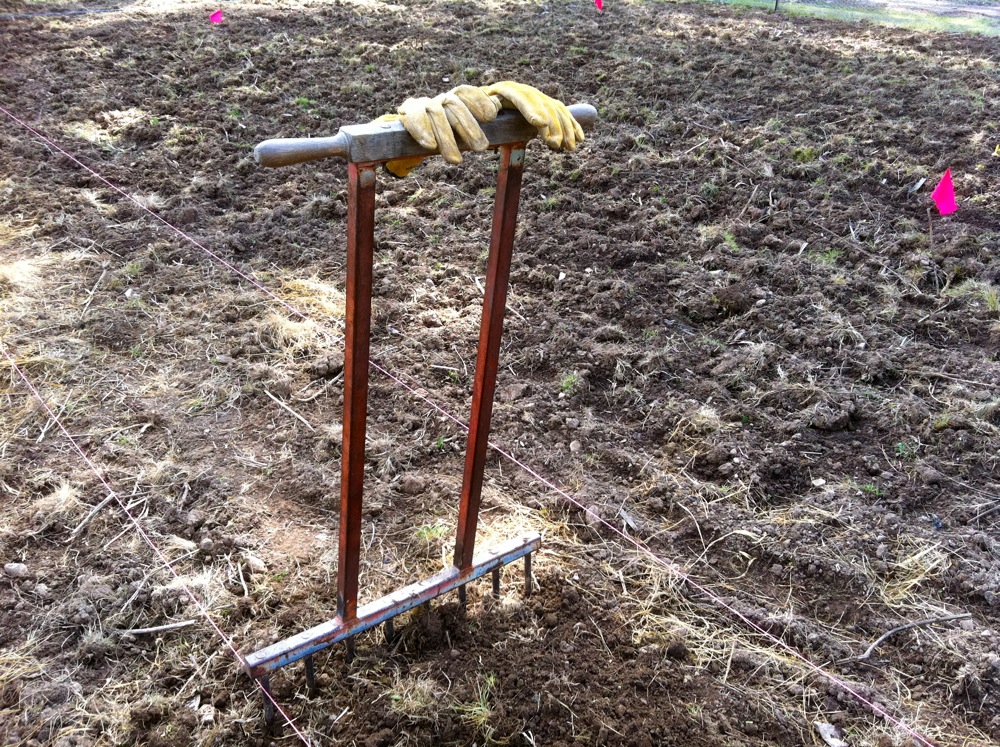
A Gundaroo Tiller of the earlier type, with wooden handles
The background of the Gundaroo Tiller goes hand in hand with the history of Permaculture in Australia. Around the same time that Bill Mollison & David Holmgren were assembling the seminal text of Permaculture One, Michael Plane of Allsun Farm was designing the Gundaroo Tiller.
Interestingly, Michael and Bill go way back to when they were Ecologists catching possums on mountain tops together, but that’s another story. Anyway, in 1980 Mike Plane settled on the design of the Gundaroo Tiller as a variation on the traditional broadfork, adapted to the heavy clay and rocky soils of Allsun Farm, near Gundaroo NSW.
Mike then began production of the Gundaroo Tiller, making them in his shed, and the device has been developing a cult following ever since with folks wanting to cultivate soil gently, on a human scale.
The basic gist of using a broadfork is both simple and powerful. You dig it in, standing on it and rocking if you need to in order to get extra depth. Once it’s in nearly all the way to the bar, you jump off, and depress the handles to your desired angle.
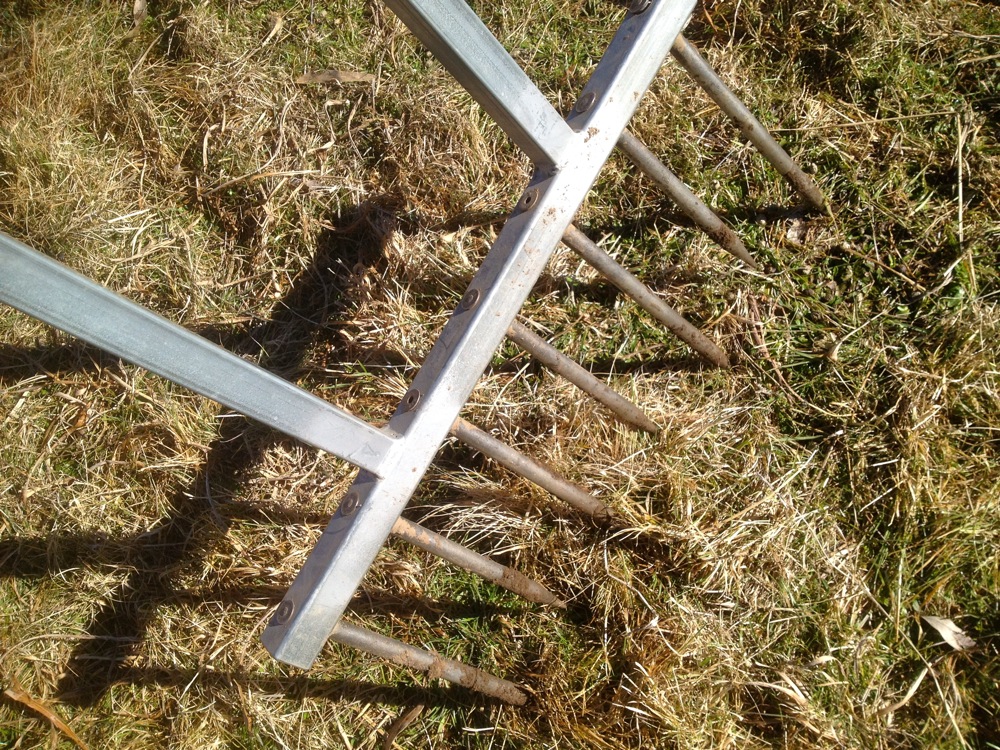
Note removable tines
Then (and this is the big important part), you slide the tiller out of the soil without inverting it, move the tiller 20cm, and start again. The end result is a column of de-compacted soil with it’s profile still upright: water and air can penetrate, but you haven’t upended the soil food web in the process. Yay.
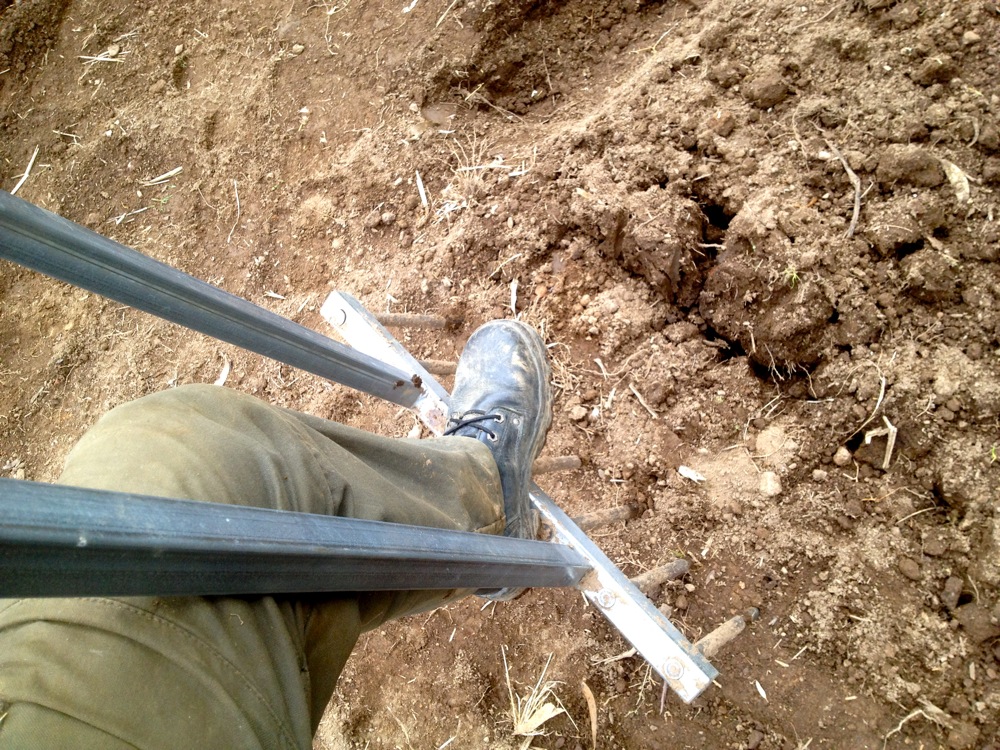
To use: push tiller straight down into soil
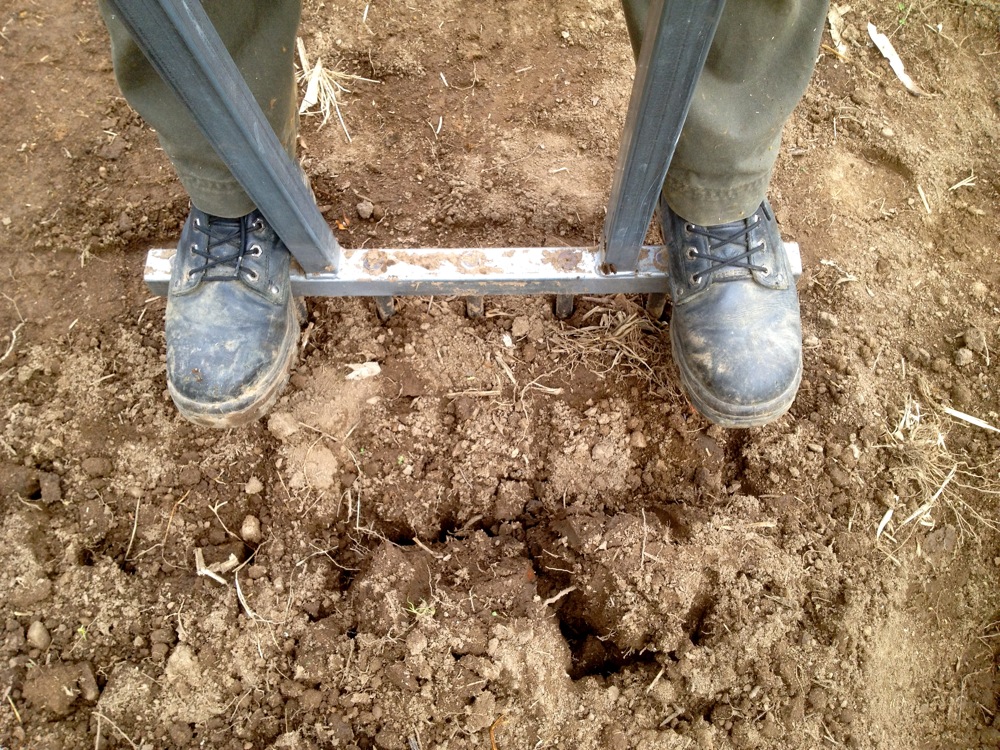
Stand on it and gently rock side to side if necessary, to get it all the way in

Pull handlebar back to 45 degrees or more, depending on soil conditions, to create aeration in soil without inverting soil profile
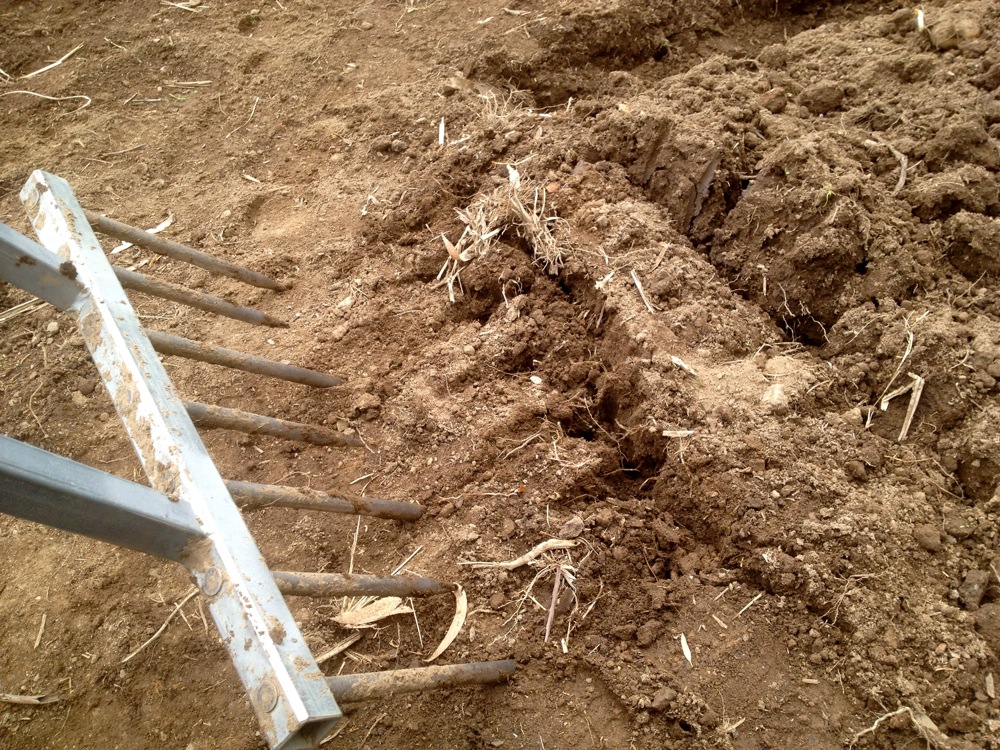
Remove tiller, slide back 20cm over ground, and repeat…
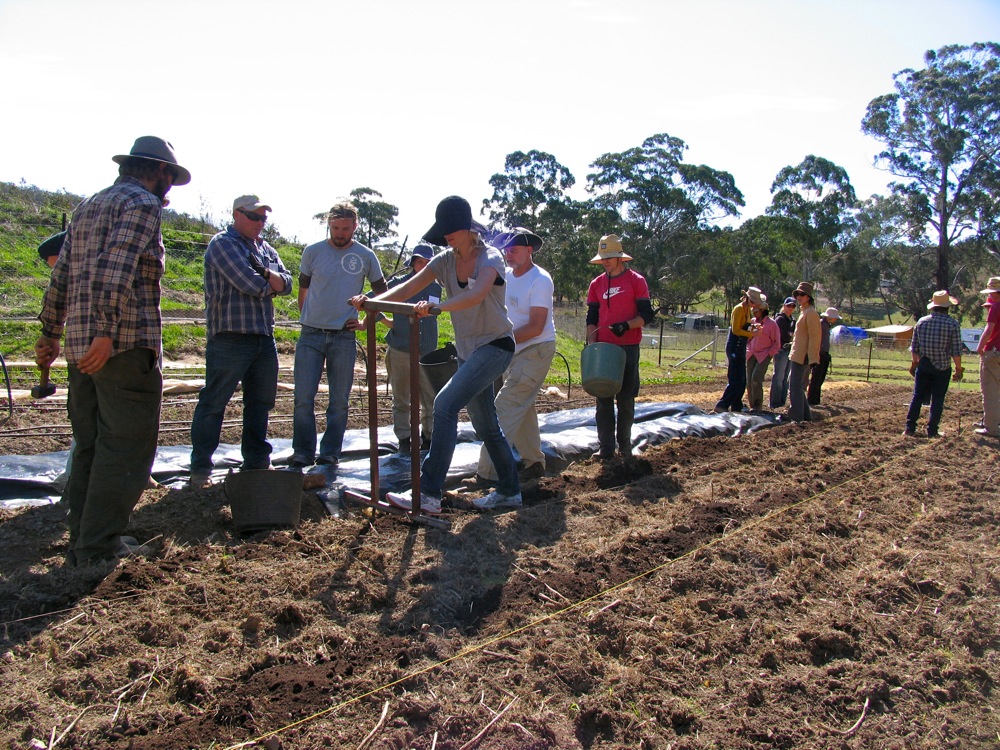
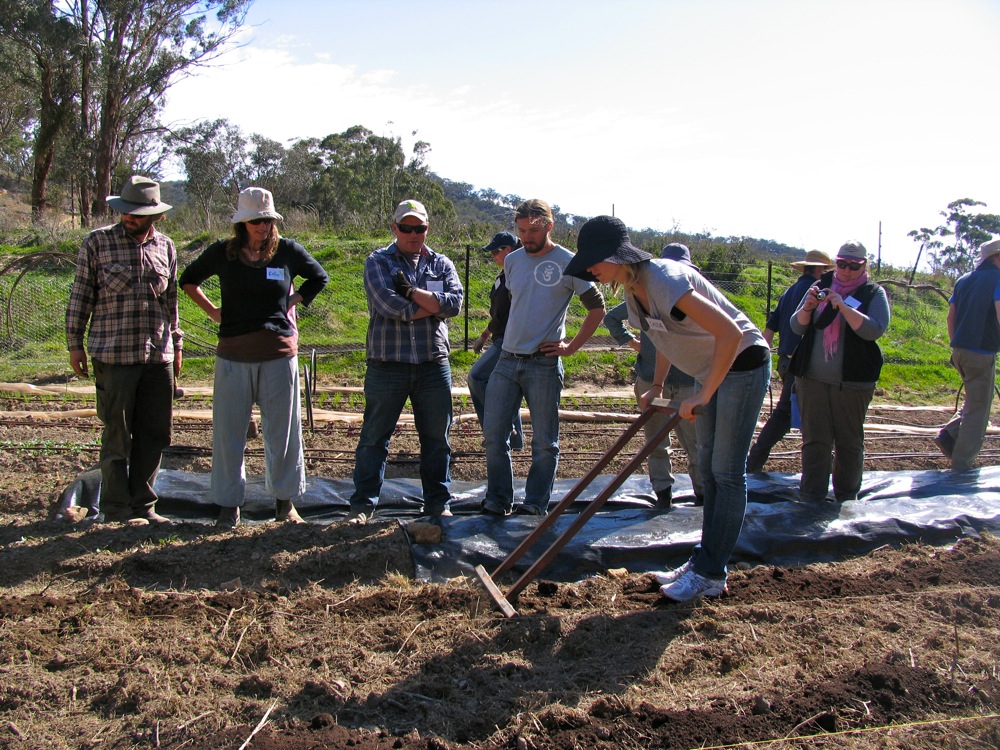
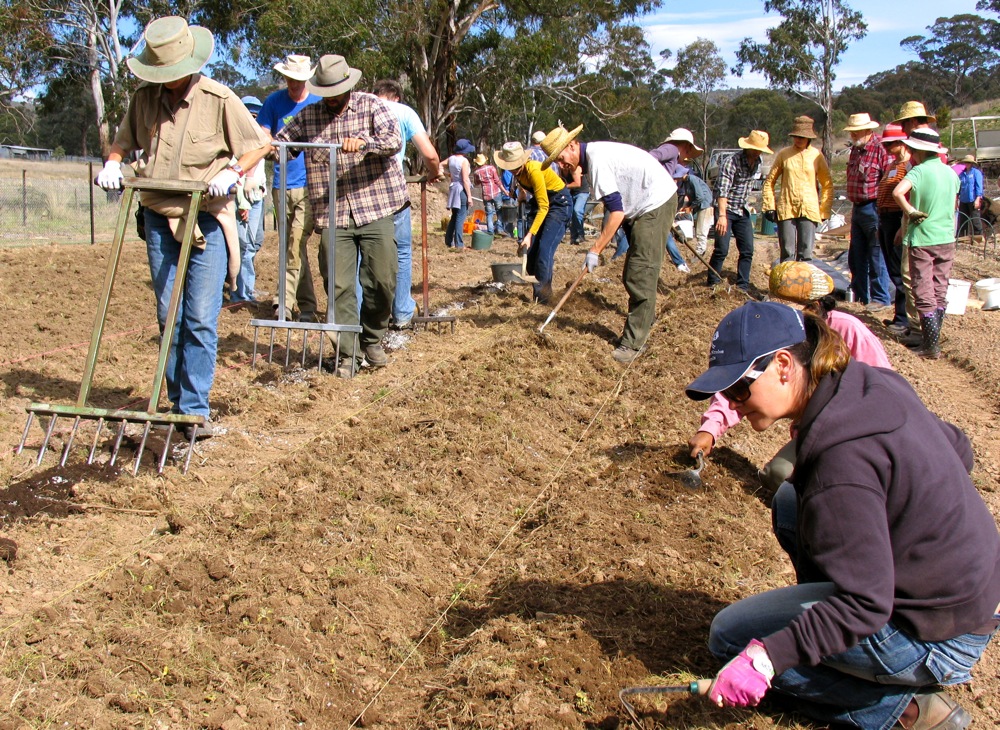
And off down the garden you go!
It should be said this this is but one part of the larger process of making up a cultivated bed for intensive annual vegetable production. But it’s a very important part both for this year and future year’s production, especially when establishing production on poor and compacted ground.
The benefits of the Gundaroo Tiller are many, but include:
- Less need for tillage (which means more soil structure integrity is retained from year to year)
- Doesn’t create a ’till pan’ of compaction beneath the bed area
- Human scale, no need for pricey motorized equipment
- Removable tines means that if you have super-compacted soil, you can remove some to make the going easier
- Ergonomic-ish
- Build like a proverbial brick structure, so a great tool to have as part of a community ‘tool share’ as it’s incredibly hard to break
- Will outlast any gardener or farmer until several generations down the line (unlike a rototiller)
Since 1980 the design has been modified slightly, and has lost the funky wooden handles in favor of an all-steel frame, for lifetime durability.
After many years of making them, Mike Plane out-sourced the production to a local crew, and the Gundaroo Tillers are now made by our mate Wade Neumann (self confessed potato nerd who supplied us with awesome seed potatoes in quantity last season) down at Mundulla in South Australia.
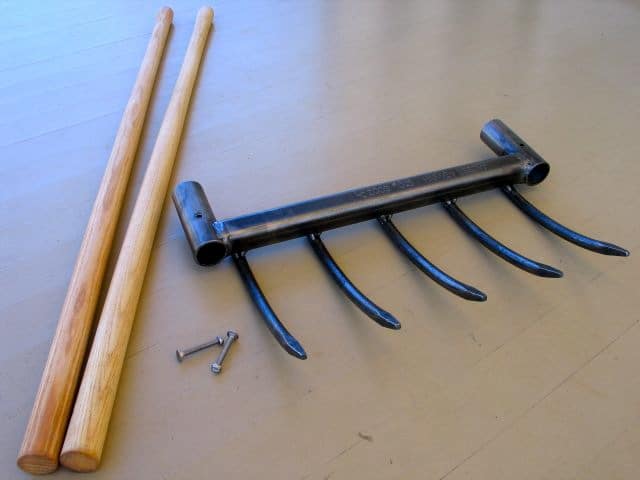
European broadfork (one of many designs)
The main difference between the Gundaroo Tiller and most european broadforks (apart from some fundamental structural differences) is that the tines on the Gundaroo Tiller are straight, not curved. Curved tines are great for highly friable, cultivated soils, but not at all good for heavy compacted clays with lots of rocks in it.
The problem is that if a curved tine broadfork hits a decent sized rock or compaction, the point of rotation is much higher because of the curved tines.
This can cause the broadfork handles to go forwards when it hits hard material, a feature that would quickly become unpractical and hard on the back, which of course results in needing to do more tilling in other ways before broad forking.
In short, the Gundaroo Tiller is made for rougher ground and heavy clay soils, to minimise the neet to do other types of tilling before the broadforking stage of bed making.
Apparently if your soil is fine, deep and friable however, the european broadforks work like a dream. Perhaps we’ll get one in 10 years time, or whenever (if ever) we get to that point of soil nirvana on Milkwood Farm.
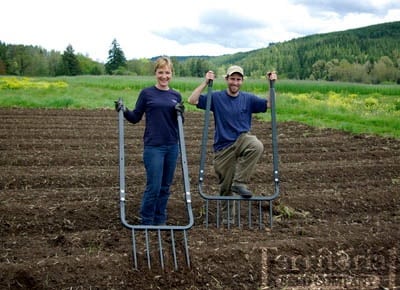
Happy American broadforkers with their eminently forkable soils (these ones actually have straight tines, just to be confusing) …
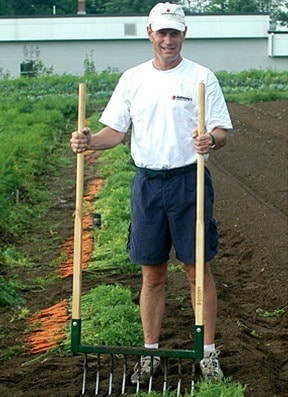
The broadfork distributed by ‘Johnny’s Seeds’, a major American non-GMO seed supplier
Just a note also that Gundaroo Tillers are a fine idea for backyard gardening as well as market garden scale production, and as said above are a GREAT addition to any community tool library so that their awesomeness can be shared.
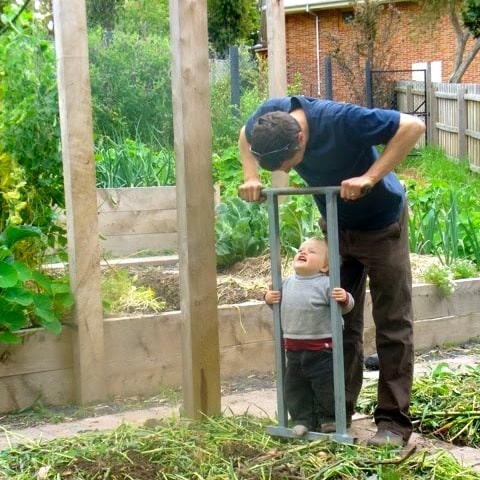
Our friend Cam Wilson doing some Gundaroo Tilling with his son Yarrow in suburban Melbourne – photo by Jessie Price
You can get a Gundaroo Tiller in either a 5-tine or a 7-tine model. If you’re not squeezed for storage space, I’d go a 7 tine model as you can always take out the removable tines from the ends if needed for a thin bed or whatever.
>> Gundaroo Tiller page at Allsun Farm’s website
Do also check out Wade Neumann’s home page at Humblehouse.biz for pics of Gundaroo Tiller construction, delicious preserves, gardening and all the other things he and his family get up to in Mundulla, SA.

Our Gundaroo Tiller over at the new market garden extension, where we’re taking pasture to intensive permaculture veggie production in one season…
>> More posts about growing annual vegetables organically and awesomely (and learning as we go)…
A good tool helps enormously. But knowing what to do with the bed once you’ve opened it up is the real skill, and that’s what our Organic Vegetable Gardening course is there to teach.
New to growing your own veggies? Our free Veggie Gardening: a Beginner’s Guide covers soil, beds and the rest of the basics, alongside tools like this one.
Thanks to Wade Neumann for taking time out from lamb marking to word me up on the differences between the Gundaroo Tiller and curved-tine broadforks, and to Mike Plane for devising such a darn useful device…